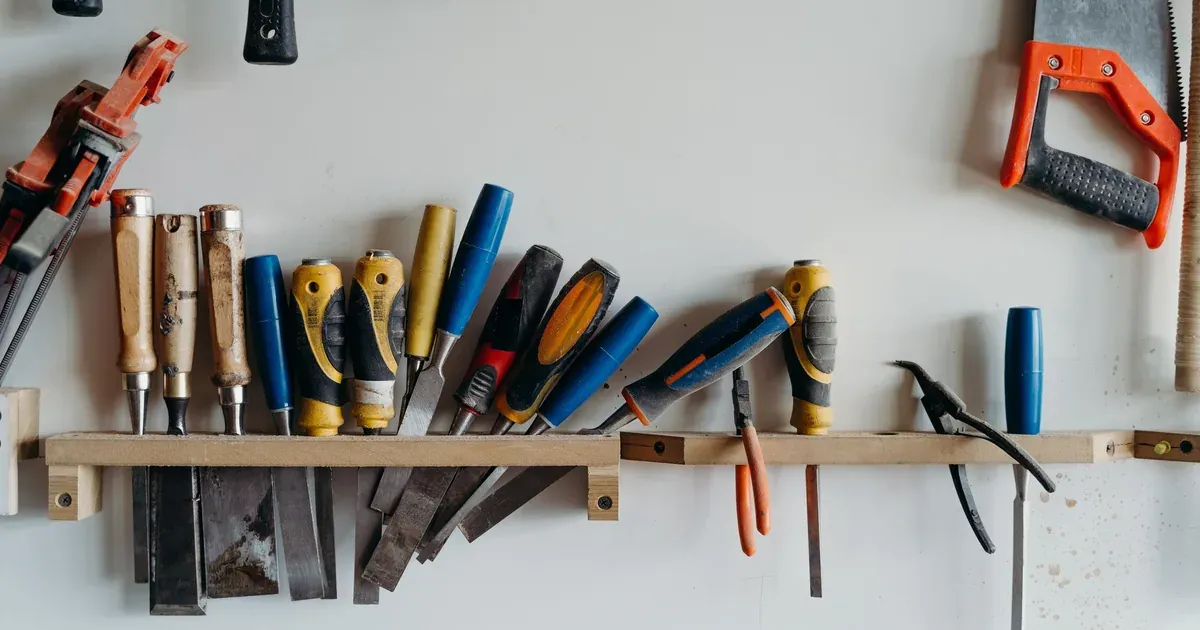
Your garage walls are basically prime real estate you’ve been ignoring for years. While the floor fills up with bikes leaning at weird angles and the workbench disappears under loose screws, the walls sit there empty — completely capable of holding all of it.
This list covers 13 wall organizer types for garages, from slatwall systems to fold-down workbenches. Not every option belongs in every garage. The goal is picking two or three that match what you actually own, not buying one giant system and hoping it fixes everything.
Why Your Garage Walls Are the Most Underused Storage Space You Have
Most garages have a floor problem that’s really a wall problem. Bikes, ladders, totes, and yard tools pile up on the ground because there’s nowhere else obvious to put them — meanwhile the walls stay bare from floor to ceiling.
Getting stuff up and off the floor does more than declutter. It keeps items away from moisture that collects near the slab, and it makes things harder for pests to nest in. A rake hanging on a rack stays drier than one propped in a damp corner.
The other mistake is treating garage storage like a one-product problem. A single big shelving unit can’t hold a rake, a bike, and a coiled hose equally well. Different items need different wall systems, which is exactly why this list has 13 entries instead of one.
1. Slatwall Panel Systems
Slatwall is a paneled wall covering with horizontal grooves that accept interchangeable hooks, baskets, and small shelves. You install the panel once, then rearrange the accessories as your storage needs shift.
It’s the most flexible option on this list. If you’ve got a mix of small-to-midsize tools, sports gear, and random garage accessories, slatwall lets you customize the layout instead of committing to fixed hook placement.
The tradeoff is setup. Slatwall costs more upfront than pegboard and takes longer to install since you’re covering a full wall section rather than hanging one board. But once it’s up, adding or moving accessories takes seconds — no new holes, no rehanging.
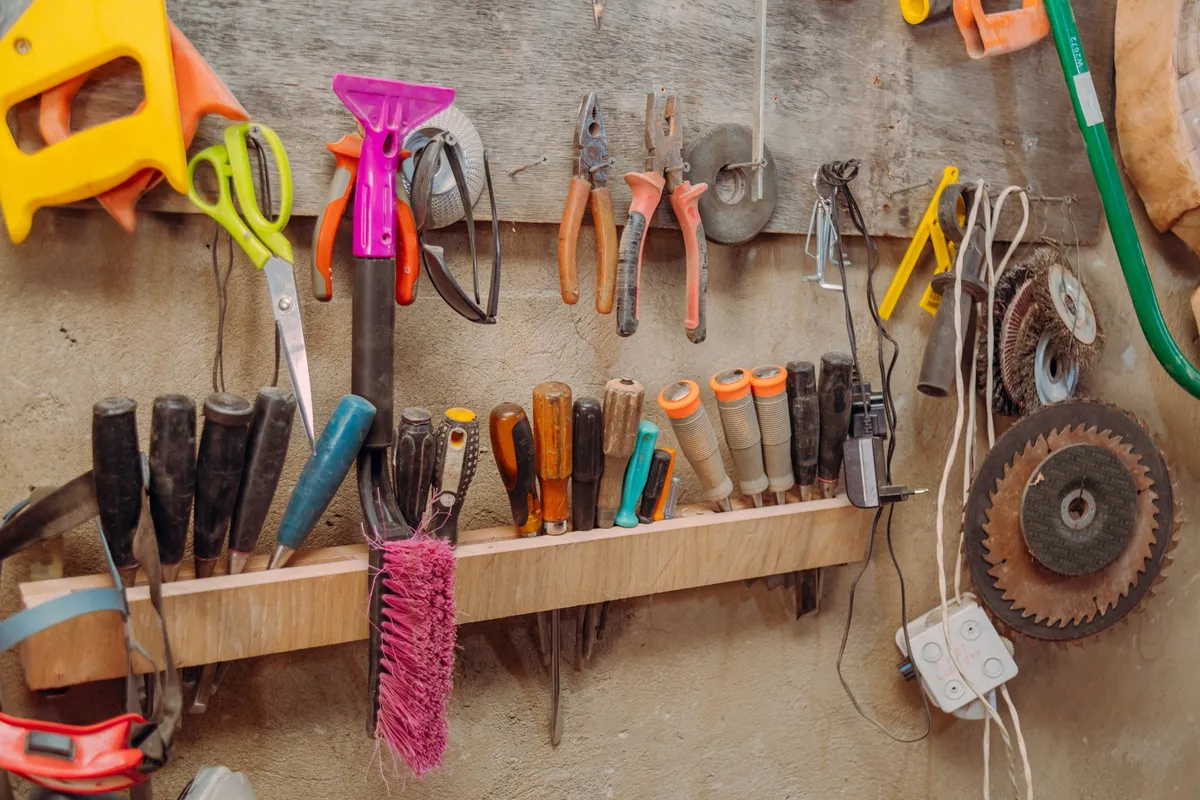
Start with one wall section — over the workbench or by the entry door — rather than paneling the entire garage on day one.
2. Pegboard with Metal Hooks
Pegboard is the classic garage organizer for a reason. A sheet of pegboard with metal hooks gives you instant, affordable wall storage for hand tools — hammers, wrenches, tape measures, anything you reach for often.
It works best mounted directly over a workbench, where you want tools visible and within arm’s reach instead of buried in a drawer. You see everything at a glance, which sounds minor until you’re not digging through a toolbox mid-project.
One detail matters more than people expect: skip standard hardboard pegboard if you’re hanging actual tools. Heavy-duty pegboard (thicker, often metal or reinforced) holds real tool weight without the holes tearing out over time. Standard hardboard is fine for lightweight items but sags under anything heavier.
3. Track-Based Rail Storage Systems
Rail systems use a horizontal track mounted to the wall, with hooks and baskets that slide and lock into position along it. Think of it as pegboard’s heavy-duty cousin — built for bulkier items pegboard can’t handle.
This is where ladders, bikes, and long-handled tools like shovels and edgers go. The sliding hooks let you rearrange placement without new holes, which matters once you realize how often garage storage needs change season to season.
Weight capacity is the detail to check before you buy. Rail systems vary a lot by brand — some hold light garden tools only, others are rated for ladders and heavier equipment. Check the listed weight rating for each hook style, not just the rail itself, before hanging anything substantial.
4. Modular Wall Cabinets
Not everything belongs on an open hook. Wall cabinets give you enclosed storage — doors that close, keeping dust, pests, and curious hands away from what’s inside.
This is the right spot for paint cans, chemicals, pesticides, or anything you don’t want a kid or pet grabbing off an open shelf. Enclosed storage also protects against dust settling on stuff you don’t use daily.
Look for cabinet units designed to mount directly into wall studs rather than drywall anchors alone. Loaded cabinets get heavy fast, and stud mounting is the difference between a stable cabinet and one that pulls away from the wall six months in.

5. Overhead-Adjacent Wall Shelving Brackets
Heavy-duty shelf brackets mounted high on the wall — just below true overhead/ceiling storage — give you a landing spot for bins and bulk supplies you don’t need daily access to.
This is prime real estate for seasonal totes: holiday decorations, off-season sports gear, camping equipment you use twice a year. Getting these off the floor frees up significant square footage for things you actually use week to week.
Pair these shelves with clear bins instead of opaque ones. You’ll be able to scan the shelf and know what’s in each tote without pulling every single one down to check — which matters when they’re stacked at shoulder height or above.
6. Bike Wall Mounts and Hooks
Bikes are notorious floor hogs, leaning against walls or laid flat, taking up space disproportionate to how often they get ridden. Wall mounts solve this without needing a dedicated bike rack’s footprint.
You’ve got two main styles: vertical hooks that hang the bike by its front wheel, and horizontal hooks that cradle the frame parallel to the wall. Vertical works well in narrow spaces; horizontal suits wider walls where you’d rather not have a bike sticking straight out.
Whichever style you choose, look for rubber-coated hooks rather than bare metal. Bare metal hooks can scratch or dent a frame over time, especially if the bike gets bumped or repositioned often. The rubber coating adds a small cushion that protects the finish.
7. Garden Tool Racks
Anyone who’s dealt with rakes and shovels sliding down a wall and clattering onto the floor knows the problem garden tool racks solve. These are spring-loaded or slotted racks designed to hold long-handled tools upright and in place.
The spring-loaded versions grip the tool handle and hold it firm even when bumped. Slotted racks work similarly, just with a fixed opening sized for handle width. Either way, the tool stays put instead of becoming a floor hazard.
These racks are compact by design, which makes them a solid option for narrow strips of wall — the leftover space between a cabinet and a doorframe, for instance, where a full shelving unit wouldn’t fit.
8. Magnetic Tool Strips
A magnetic tool strip is exactly what it sounds like: a strip of strong magnets mounted to the wall that holds metal tools in place without hooks or slots. Wrenches, screwdrivers, metal rulers — anything ferrous sticks right to it.
The appeal is speed, both in setup and daily use. Mounting takes minutes with a couple of screws or heavy-duty adhesive strips, and grabbing a tool means a quick pull rather than untangling it from a hook or digging through a drawer.
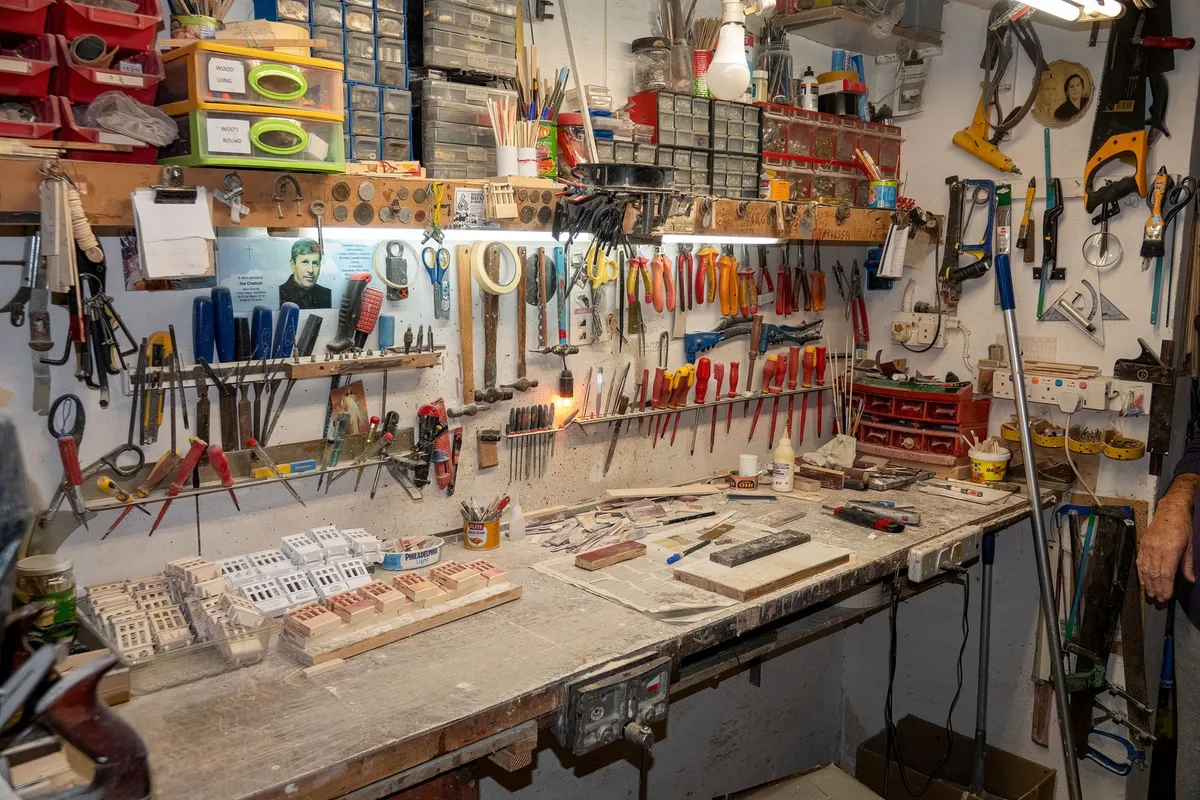
These work best positioned right at the workbench, holding the handful of tools you reach for constantly. It’s not meant to store your whole toolkit — just the frequently-grabbed items you don’t want buried anywhere.
9. Clear Bin Wall Shelving Combos
These are shelving units built with dimensions specifically sized for stackable clear storage bins, rather than general-purpose shelves you happen to put bins on. The fit is tighter and the bins sit more securely as a result.
This setup shines for small parts, spare hardware, and seasonal decor — categories of stuff that are annoying to store loose but don’t need their own cabinet. Screws, holiday lights, extra fasteners all do well here.
Label every bin, even though they’re clear. You can usually see the general contents through clear plastic, but a label saves you from squinting at a shelf trying to tell “picture hooks” apart from “cabinet hardware” from four feet away.
10. Extension Cord and Hose Reels
Loose extension cords and hoses turn into tangled piles fast, usually in a heap on the floor or draped over whatever’s nearby. Wall-mounted reels keep them wound and off the ground entirely.
The reel mounts to the wall, the cord or hose winds around it, and you pull out only the length you need for the job. When you’re done, it winds back instead of getting coiled by hand and shoved onto a shelf.
Look for reels with a swivel mount if you can. A fixed mount only lets you pull cord from one direction, which gets annoying fast; a swivel mount lets you pull from wherever you’re standing. These also free up hook space elsewhere since the cord isn’t looped over a random peg.
11. Corner Wall Shelves
Corners are the space every garage wastes. Standard shelving doesn’t wrap around a 90-degree angle, so that triangular chunk of wall usually sits empty — corner shelves are built specifically to use it.
These work well for small bins, spray bottles, or overflow items that don’t need a full shelf run of their own. It’s not high-capacity storage, but it’s free square footage you weren’t using anyway.
The triangular brackets that support these shelves keep the footprint minimal, which matters in a garage where floor and wall space near the corner might also be doing double duty — like where a workbench meets a side wall.
12. Modular Hook-and-Basket Combo Kits
If you’re not sure yet what your garage actually needs, a modular hook-and-basket kit is a reasonable place to test the waters. These are all-in-one starter sets that bundle a small mounting rail or board with an assortment of hooks, baskets, and mini shelves.
They’re especially useful for renters or first-time garage organizers who don’t want to commit to a full slatwall or cabinet system before knowing what gets used. You install the kit, live with it for a few weeks, and see what you reach for.
The best part is expandability. Most kits let you add matching hooks or baskets later, so if the starter setup works, you’re not starting over — you’re just adding onto what’s already mounted.
13. Fold-Down Wall-Mounted Workbenches
For garages too small to dedicate permanent floor space to a workbench, a fold-down wall-mounted bench solves the real estate problem directly. It mounts flat against the wall and folds down into a usable work surface only when you need it.
When folded up, it essentially becomes part of your wall storage system — flush enough that it doesn’t eat into walking space or parking clearance. Fold it down, and you’ve got a flat surface for projects that need one.
Pay attention to the weight rating before buying. These benches vary in what they can support, and a bench rated for light hobby work won’t hold up under heavier project loads. Match the rating to what you’ll actually be doing on it.
Where to Start: Building Your Garage Wall System
Don’t try to redo the whole garage in one weekend. Pick a single zone — the wall above your workbench, or the wall by the entry door — and organize that section completely before expanding anywhere else.
Within that zone, mix at least two organizer types rather than relying on one. A pegboard with metal hooks for daily-use hand tools paired with a clear bin wall shelving combo for small parts covers two very different storage needs in the same few square feet.
The overall principle across all 13 options here: match the organizer to what you’re storing, not the other way around. A bike doesn’t belong on a magnetic strip, and screws don’t belong on a bike hook. Once you’re thinking in terms of “what does this item need” instead of “where can I cram this,” the right combination gets obvious fast.
For deeper dives, check out How to Organize a Garage Workbench Step by Step, Garage Storage Ideas for Small Garages, and How to Declutter Your Garage in a Weekend once you’re ready to expand past your first wall.
FAQ
What is the best wall organizer for a garage with limited space?
Slatwall or pegboard systems are the most space-efficient because they use vertical wall area you already have and can be customized as your storage needs change. Start with one section over your workbench before expanding to a full wall.
Can I install garage wall organizers without drilling into drywall?
Most heavy-duty garage organizers should be mounted directly into wall studs or a French cleat system rather than drywall alone, since garage items are often heavy. If you’re renting, look for freestanding shelving or clamp-on options instead.
How much weight can garage wall organizers hold?
It varies widely by product and mounting method — pegboard and slatwall panels typically hold light-to-medium tools, while rail systems and cabinets rated for stud-mounting can hold much more. Always check the manufacturer’s weight rating before hanging anything heavy.
If you only do one thing this weekend, mount a pegboard with metal hooks over your workbench. It’s the cheapest entry point on this list, takes an afternoon, and you’ll feel the difference the very next time you reach for a wrench instead of digging through a bin for it.