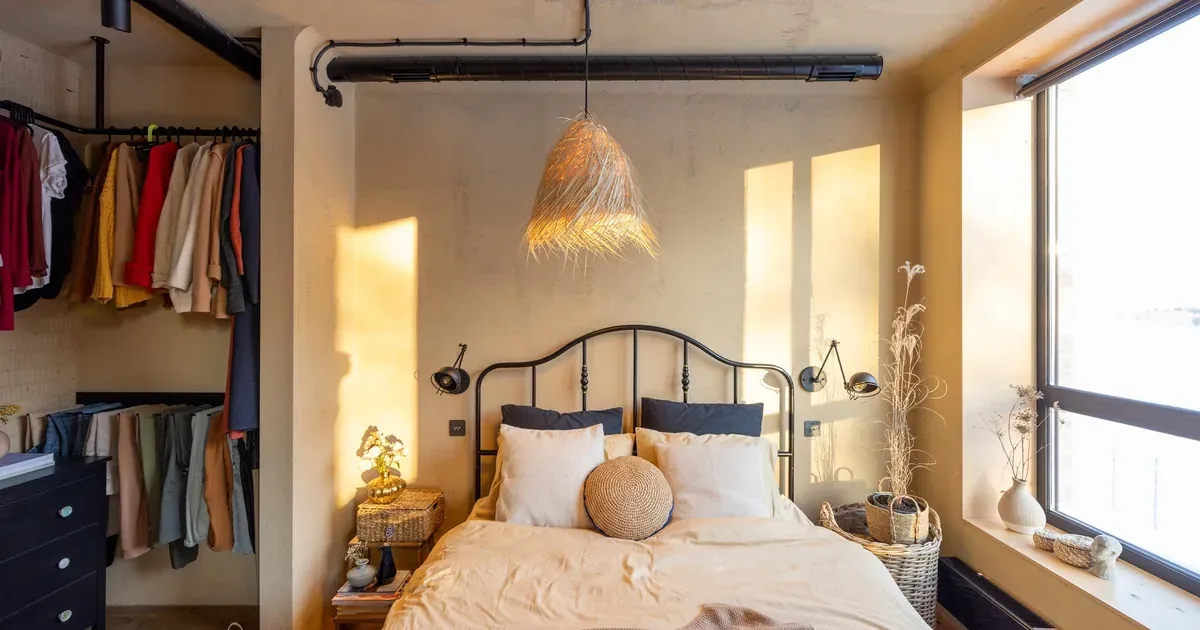
If your bedroom is small, you already know the feeling: you walk in, and instead of relaxing, you immediately feel a little tense. Too much stuff, not enough space, nowhere to put anything. It’s exhausting.
Here’s the thing — most small bedroom problems aren’t actually about square footage. They’re about storage gaps and furniture choices that aren’t pulling their weight. Fix those, and even a 100-square-foot room can feel like a place you actually want to be.
This list covers 15 actionable ideas across four categories: storage, furniture, layout, and decor. Some take an afternoon. Some take 20 minutes. A few cost nothing at all. You don’t need to do all 15 — pick the ones that match your situation and start there.
Why Small Bedrooms Feel Overwhelming (And How to Fix It)
Visual clutter is the main culprit. A room packed with mismatched furniture, flat surfaces covered in stuff, and nowhere obvious to put anything registers as chaotic — even if everything is technically “put away.”
The good news: a few targeted changes, not a full renovation, can shift how a room feels dramatically. You’re not fixing the square footage. You’re fixing how that square footage is being used.
The 15 ideas below break into four loose categories:
- Storage upgrades — ideas 1, 5, 6, 11, 12 (getting more space out of what you have)
- Furniture swaps — ideas 2, 3, 4, 8 (replacing bulky pieces with smarter ones)
- Layout and habits — ideas 10, 14, 15 (rethinking what’s in the room and where)
- Visual tricks — ideas 7, 9, 13 (making the room feel bigger without moving a thing)
1. Use a Bed Frame With Built-In Storage Drawers
Under-bed space is one of the most wasted areas in any small bedroom — and a storage bed frame fixes that instantly. Instead of that shadowy no-man’s-land under your mattress (where things go to collect dust), you get actual drawers with real capacity.
A good storage bed frame can replace your dresser entirely in a very small room. The drawers are ideal for bulky items: extra bedding, seasonal clothes, shoes, out-of-rotation clothing.
When you’re shopping, look for a few specific things:
- Full-extension drawer glides — so you can actually access the back of the drawer
- Weight capacity — especially if you’re storing heavier items like jeans or shoes
- Clearance height — you want enough room to open drawers without hitting the bed frame
- Finish that matches your room — these frames come in everything from upholstered to wood
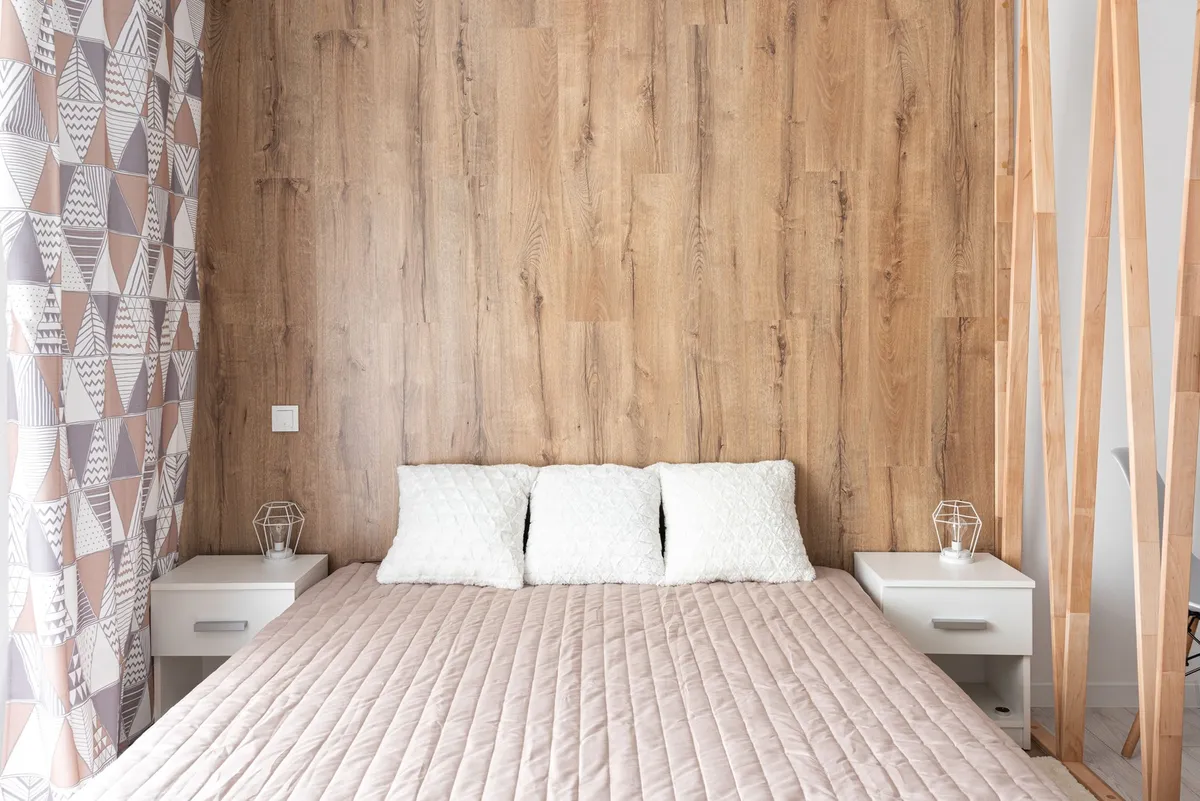
Storage bed frames are widely available at IKEA, Wayfair, and Amazon in every size from twin to king. If you’re buying one piece of furniture to solve your small bedroom problem, this is the one.
2. Add Floating Shelves Instead of Bulky Furniture
Every piece of furniture sitting on your floor is using square footage. Floating shelves use wall space instead — and that trade is almost always worth making in a small bedroom.
They’re great for books, a small alarm clock, a plant, a glass of water at night, or a few small decor items. Things that would otherwise be piled on a nightstand or dresser top.
For renters, Command adhesive shelves work for lighter items (think: a paperback and a small candle). Homeowners can go with standard bracket-mounted shelves that hold more weight and feel more permanent.
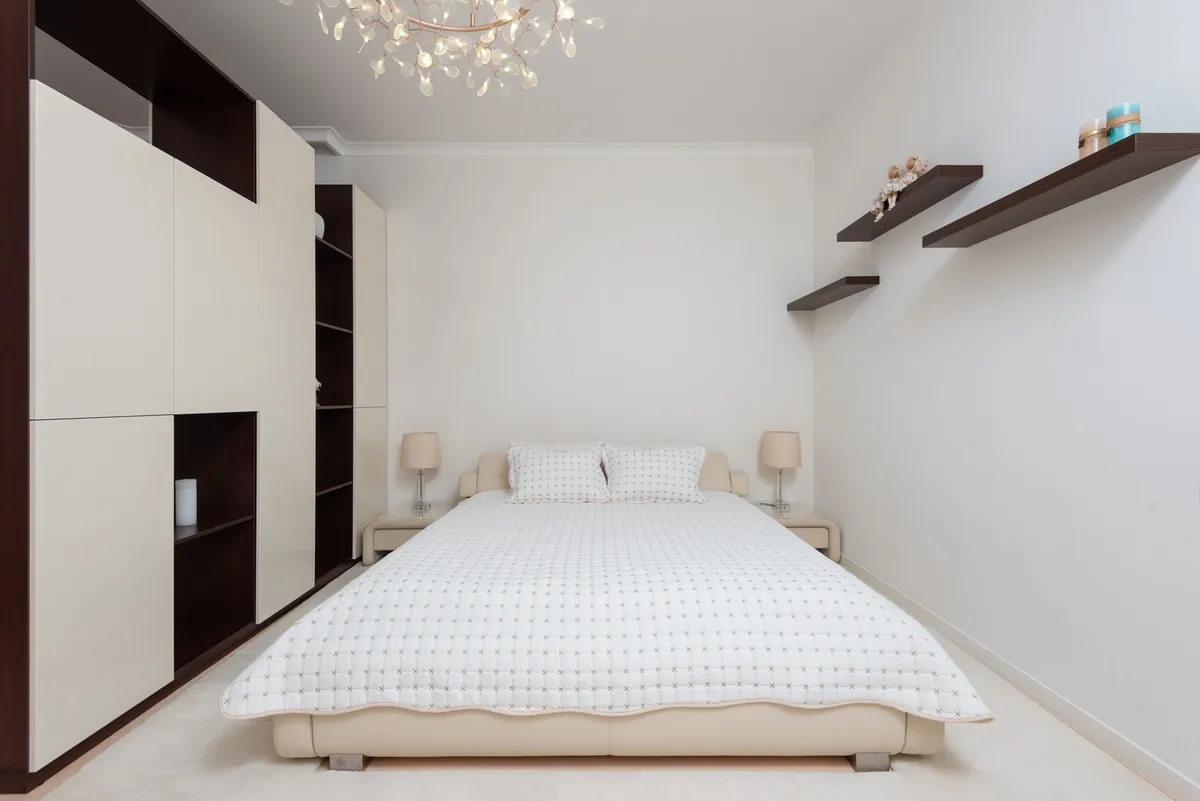
A few tips for keeping floating shelves from looking cluttered:
- Limit each shelf to 3-5 items max
- Group things by size (tallest in back or at one end)
- Leave some breathing room — an empty shelf is not a problem
3. Mount Your Nightstand to the Wall
A traditional nightstand takes up roughly 2-3 square feet of floor space on each side of the bed. In a small bedroom, that’s significant. A wall-mounted floating nightstand takes up zero floor space — and it makes the room feel noticeably more open because you can see the floor all the way to the wall.
If you want to DIY it, a small floating shelf (about 10-12 inches deep) plus a power strip velcroed underneath works perfectly. Add a small hook on the side for headphones and you’ve built a better nightstand than most store-bought options.
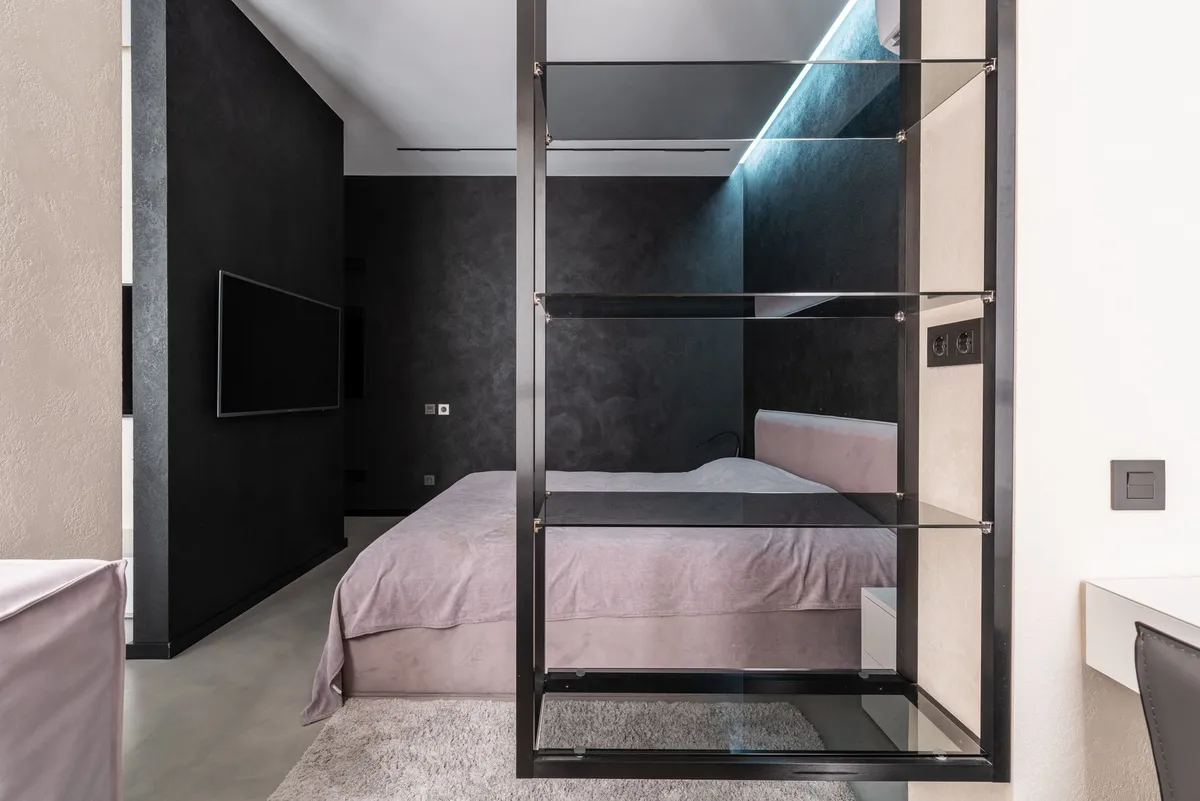
When choosing a wall-mounted option, look for one with at least a small lip or shallow drawer. Things slide off flat shelves at 2 a.m. more than you’d expect.
4. Use Vertical Space With a Tall Wardrobe or Armoire
If your bedroom has no closet — or a closet that’s embarrassingly small — a tall wardrobe is the move. The key word is tall. You’re trading floor space for ceiling height, and that’s a smart trade.
A wardrobe that goes to (or near) the ceiling gives you significantly more storage than a squat dresser-and-mirror combo, and it doesn’t actually take up more floor space.
Inside, make it work harder:
- Add a second hanging rod below shorter items (jackets, shirts) to double hanging capacity
- Use shelf dividers to keep folded items from toppling
- Mount hooks on the inside of the doors for belts, scarves, or tomorrow’s outfit
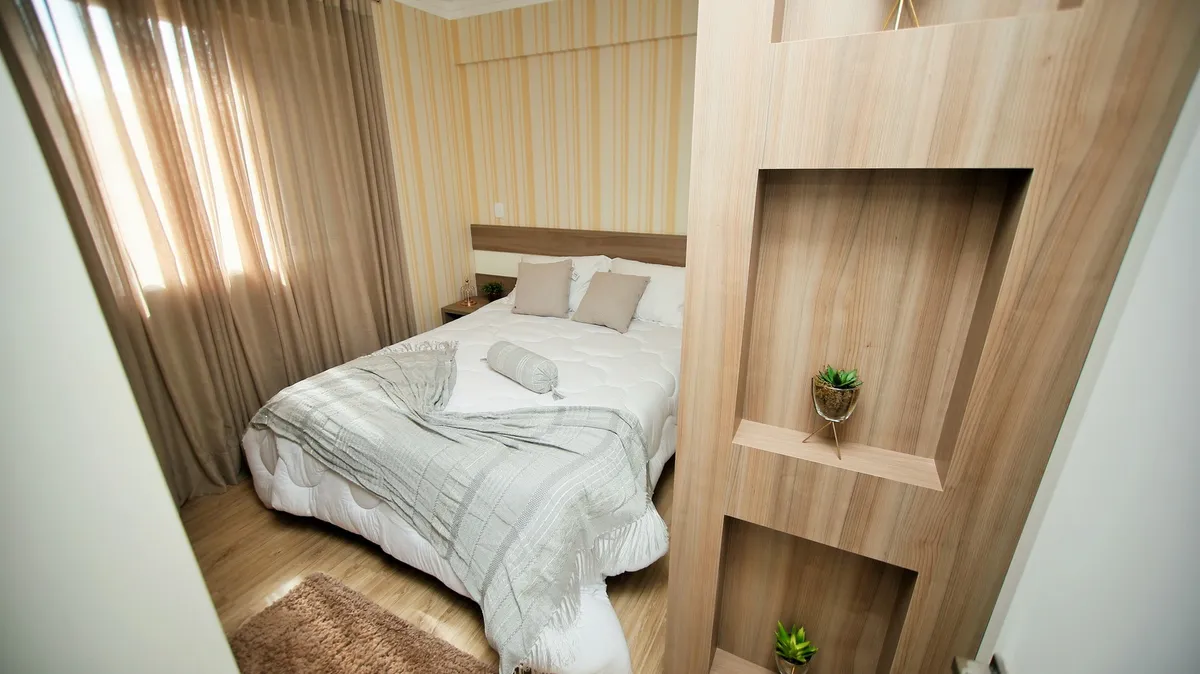
The IKEA PAX system is the most customizable option in this category and widely available. Avoid adding a second large piece of furniture (like a separate dresser) if the wardrobe is doing the job — doubling up on big furniture is how small rooms get suffocating.
5. Maximize Your Closet With a Simple Organizer System
Even a small reach-in closet has more potential than it looks like. Most closets ship with one hanging rod and one shelf — and that’s a terrible use of the space.
Before you buy anything: do a closet audit first. Pull everything out, remove items that don’t belong in the bedroom (holiday decorations, random boxes), and reassess what actually needs to live there.
Then add:
- A double hang rod to stack shorter items (shirts and jackets) and instantly double your hanging capacity
- Shelf dividers to keep folded stacks from leaning and collapsing
- An over-the-door organizer on the inside closet door for shoes, accessories, or folded items
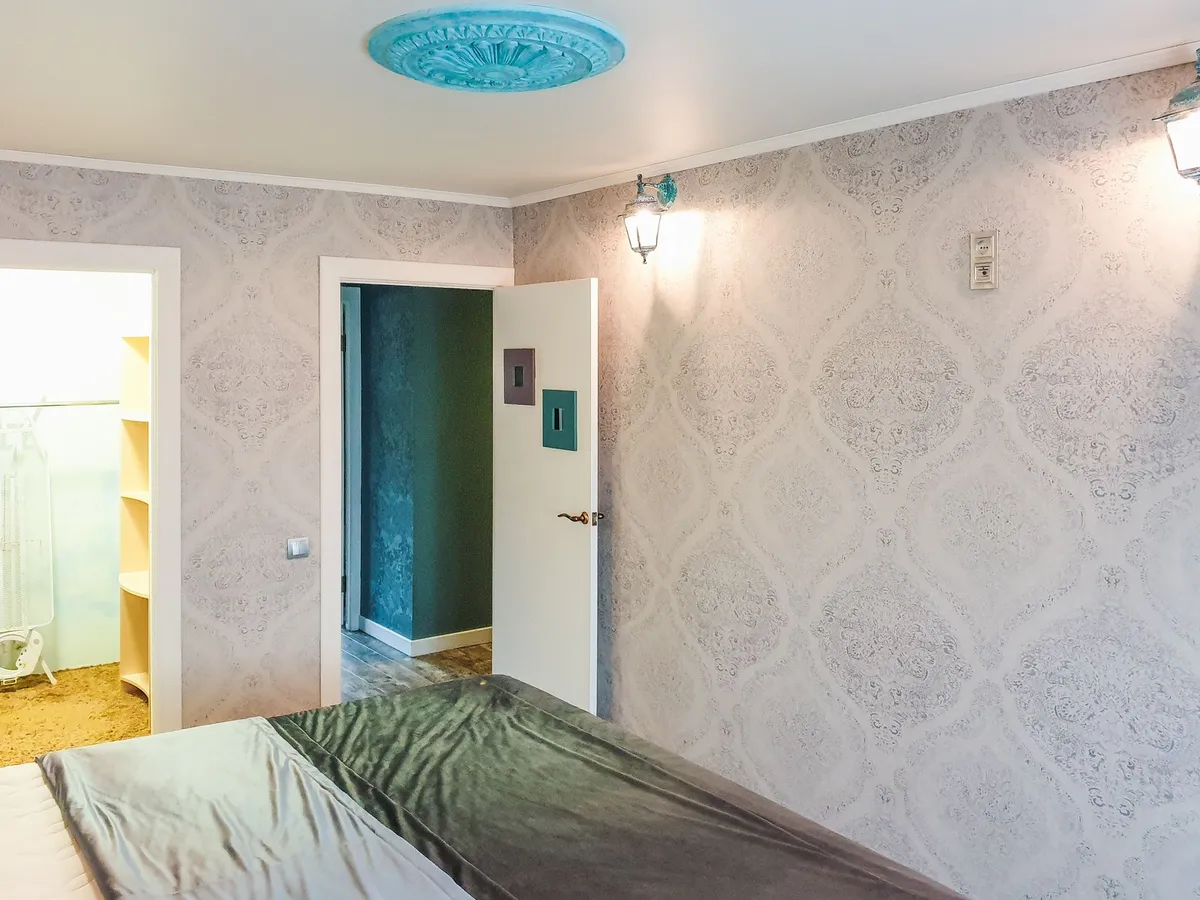
Over-the-door organizers deserve a special mention here. The back of a closet door is completely unused in most bedrooms — it can hold 12-24 pockets of stuff without taking up a single inch of floor or shelf space. These are available at Target, Amazon, and The Container Store in a range of sizes and styles.
For more on this topic, check out Small Closet Organization Ideas for a Bedroom With No Space.
6. Try an Ottoman or Bench With Hidden Storage at the Foot of the Bed
A storage ottoman at the foot of your bed is one of those furniture pieces that earns its keep three times over: it’s seating, it’s storage, and it visually anchors the bed so the room feels finished.
Inside the ottoman, you can store extra throw pillows, a spare blanket, pajamas, workout gear, or anything else that ends up sitting out because it doesn’t have a home.
When sizing it, aim for something roughly as wide as your bed (or a bit narrower). You want a clear walking path on both sides — if the ottoman blocks traffic, it’ll feel cramped instead of intentional.
A lift-top storage ottoman (versus one you have to remove completely to open) makes day-to-day access much easier. Storage ottomans are widely available at Amazon, Target, and HomeGoods across a range of styles from minimal to tufted.
7. Hang Curtains High and Wide to Make the Room Feel Larger
This one sounds like a decorating tip, but it’s actually visual architecture. Where you mount your curtain rod determines how tall your room looks.
Most people mount the rod just above the window frame — which makes the window look like a window. If you mount the rod 4-6 inches below the ceiling instead, the curtain hangs all the way from ceiling to floor, and the eye reads the ceiling height differently. The room looks taller.
Do the same thing horizontally: extend the rod 6-12 inches beyond each side of the window frame. The window appears wider. More light comes in from the sides. The wall looks more expansive.
For fabric, light sheers or linen-look panels in white or off-white keep the room bright and airy. Heavy dark curtains in a small bedroom make it feel like a cave — save those for a different room.
This is one of the cheapest visual transformations on this list. Curtain rods and sheer panels are affordable at Target and Amazon, and installation takes under an hour.
If you’re skimming, slow down for the next section — it’s especially useful if you have kids or share a bedroom.
8. Choose a Loft Bed or Bunk Bed for Kids’ Small Bedrooms
A loft bed does something almost magical in a small room: it takes the entire floor footprint of the bed and gives it back to you. The bed lives up top, and the space underneath becomes usable floor space — for a desk, a small dresser, a reading nook, or a play area.
For kids’ rooms especially, this can turn a cramped single-purpose room into a functional space that actually works.
When choosing a loft bed, look for options with:
- Built-in desk underneath (saves buying one separately)
- Built-in shelving on the sides or ends
- Drawers or storage stairs instead of a plain ladder
- Guardrail height appropriate for the child’s age
- Verified weight limit — some budget options are lower than labeled
Loft beds and bunk beds with storage or desk features are available at Amazon and Wayfair in a wide range of styles and price points.
9. Use Mirrors Strategically to Open Up the Space
A large mirror in a small bedroom does two things: it reflects light (making the room brighter) and it creates the visual impression of depth (making the room feel larger). It’s not an illusion exactly — it’s just using light more effectively.
A full-length mirror leaning against the wall is the easiest implementation. It’s renter-friendly, requires no installation, and has a casual, intentional look that works in most bedroom styles. If you have mirrored closet doors — keep them. They’re doing real work.
Placement matters: position the mirror where it reflects a window or a relatively tidy area of the room. A mirror that reflects a cluttered corner just doubles the chaos.
Framed full-length mirrors are available at Target, Amazon, and IKEA at accessible price points across many styles.
10. Declutter Ruthlessly and Use the ‘Bedroom Items Only’ Rule
This is the single fastest way to make a small bedroom feel bigger — and it costs nothing.
The rule is simple: if it isn’t related to sleep, getting dressed, or rest, it doesn’t live in the bedroom. That sounds obvious, but walk through your room right now and count how many things violate it.
Common offenders:
- Gym equipment (even a single set of dumbbells takes up visual and physical space)
- Paperwork, bills, laptops in “I’ll deal with it” piles
- Hobby supplies that migrated in and never left
- Kids’ toys, games, or school projects
- Bags and purses that got set down months ago
Set a timer for 20 minutes. Walk through the room and remove everything that doesn’t pass the test — don’t organize it, just remove it. Pile it outside the door to deal with later.
That 20 minutes will do more than most furniture purchases. It’s also the prerequisite for everything else on this list. An organized storage system in a cluttered room just hides the mess temporarily.
For a more detailed approach, see How to Declutter Your Bedroom in 30 Minutes or Less.
11. Use Under-Bed Storage Bins for Items That Don’t Fit Elsewhere
If your bed frame doesn’t have built-in drawers (see idea 1), flat rolling under-bed bins are your next best option. They’re not glamorous, but they’re practical and they use space that’s otherwise completely wasted.
Before buying, measure the clearance under your bed frame. Most frames have somewhere between 7 and 13 inches — and it matters, because not all bins will fit all clearances.
If your frame sits low to the ground, bed risers can add several inches of clearance. They’re inexpensive and widely available at Target and Amazon. Just make sure your frame can use them safely (most can, but check the frame style first).
Label every bin. Seriously. Unlabeled under-bed bins become black holes where seasonal sweaters go to disappear for two years.
12. Add Over-the-Door Organizers to Every Door
The back of a door is free real estate that almost everyone ignores. In a small bedroom, you can’t afford to.
The back of your bedroom door, your closet door, and any adjacent door can all hold organized storage without taking up a single inch of floor space. This is especially valuable for renters who can’t install shelving.
What to put where:
- Main bedroom door: hooks for tomorrow’s outfit, a robe, bags, or a towel
- Closet door: a pocket organizer for shoes, accessories, scarves, or folded items
- Back of a bathroom door (if adjacent): toiletries, hair tools, cleaning supplies
Over-the-door shoe organizers get bonus points for versatility — they work for shoes, yes, but also for everything small that needs a home. Hair ties, sunscreen, phone chargers, nail polish. If it fits in the pocket, it’s organized.
13. Keep the Color Palette Light and the Surfaces Clear
Light-colored walls and bedding make a small room feel more open. This is a consistent finding in interior design, and it works whether you’re painting or just switching out your bedding.
You don’t need white everything — soft warm neutrals, pale greiges, muted blues, and light sage all work. The goal is to avoid heavy, dark colors that absorb light and make walls feel closer.
But the color is only half of it. Cluttered surfaces — dresser tops piled with things, nightstands with three layers of stuff — make even organized rooms feel cramped. A clear surface reads as intentional. A covered surface reads as chaotic.
One rule that helps: one-in-one-out for surfaces. Before you set something new on the dresser, something already there gets put away or moved. It sounds strict, but it prevents the slow creep of surface clutter that happens over weeks without you noticing.
14. Rethink Your Furniture Layout Before Buying Anything New
Most people never move their furniture from wherever it landed when they moved in. That’s understandable — moving furniture is annoying. But it might be the single most impactful free change you can make.
The most common layout mistake in small bedrooms: the bed is placed in the center of a wall, pulling furniture away from the walls on both sides and eating the walking path. Pushing the bed into a corner — or at least flush against one wall — can reclaim a meaningful amount of usable floor space.
A few layout principles that help:
- The bed should not block the door or natural traffic path
- Aim for one “generous” open space in the room, even if it’s small
- If removing one piece of furniture creates flow, that furniture doesn’t need to be there
Before physically moving heavy pieces, use a free app to test layouts virtually. IKEA Place and Planner 5D both let you map a room and drag furniture around — 30 minutes of virtual moving beats an afternoon of physical rearranging.
15. Create a ‘Drop Zone’ Outside the Bedroom to Stop Clutter at the Door
Here’s the thing about bedroom clutter: most of it doesn’t start in the bedroom. It starts in your hands as you walk through the door — a bag, a jacket, a random item from the car, something you meant to deal with — and it gets set down “just for a minute.”
The solution isn’t more discipline. It’s a better system.
A small hook-and-shelf setup just outside your bedroom door (or even a single over-the-door hook on the outside of the door) creates a catch zone for all of that. Bags land there. The jacket you wore today lands there. The random item that doesn’t have a home lands there, and you deal with it the next morning.
This one habit shift does more to prevent the cycle of constant bedroom re-decluttering than almost anything else. You’re stopping clutter at the point of entry instead of dealing with it after it’s already scattered across your room.
Hallway hooks and small wall-mounted shelves for this purpose are affordable and available at Amazon, IKEA, and Target.